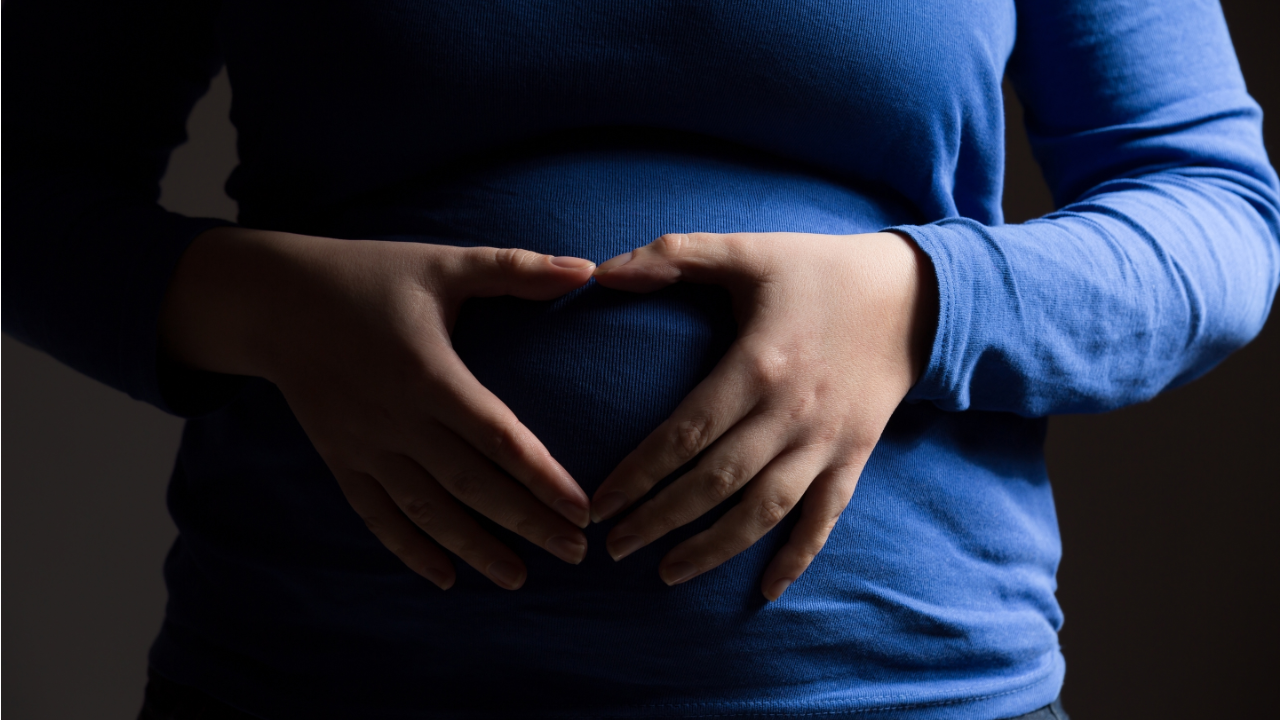
The Real Reason Your Tummy Still Looks Pregnant
Jun 03, 2026You've lost the baby weight. Maybe most of it. Maybe all of it. But your tummy still pouches forward, still looks rounded, still doesn't feel like yours and nobody can tell you why.
So you do more crunches. You cut more carbs. You wonder what's wrong with you.
Nothing is wrong with you. But something is going on and it's not what you've been told.
Here's what most moms are never told after having a baby: your core doesn't automatically heal. In fact, for a lot of us, it can't heal on its own especially if we go back to the wrong exercises too soon. That pouch you're carrying isn't a fat problem. It's a core problem. And once you understand what's actually happening inside your body, everything starts to make sense.
What Diastasis Recti Actually Is (And Why Nobody Explained It to You)
Diastasis recti (DR) is the separation of your rectus abdominis muscles. Those are the two columns of muscle that run down the front of your abdomen, held together by a band of connective tissue called the linea alba.
During pregnancy, your uterus expands and pushes those muscles apart. That's completely normal. Your body is doing exactly what it needs to do to make room for your baby. The problem isn't the separation itself. It's what happens after.
For your core to function properly, that connective tissue needs to regain its tension. In a lot of moms, it doesn't. The gap stays wide, or the tissue stays soft and loose even if the gap closes. And when that happens, your deep core can't generate the pressure and support it's supposed to.
The result? A tummy that still protrudes not because of fat, but because the internal support structure underneath isn't doing its job. Your organs have less to hold them in place. Your posture compensates. Your lower back works harder. And no amount of weight loss changes any of that, because weight loss doesn't rebuild connective tissue.
This affects more moms than most people realize. Research suggests that around 60% of women have some degree of DR immediately postpartum and for many, it persists months or even years later without the right kind of attention.
Why Crunches Are Making It Worse
This is the part that stops most moms cold because crunches are the first thing we reach for when we want to "fix" our stomach.
Here's what's actually happening when you do a crunch with unhealed DR: instead of activating your deep core muscles, you're creating intra-abdominal pressure that pushes outward against a gap that's already compromised. You're essentially pressurizing a weakened tube. The more you do it, the more you widen or worsen the gap, and the more the connective tissue gets stressed in exactly the way it doesn't need.
It's not just crunches either. Sit-ups, leg raises, heavy lifting with poor breath mechanics, and intense ab work all create that same downward and outward pressure. If you've been grinding through these and wondering why your core looks and feels worse instead of better, now you know.
The fix isn't to do more. It's to do different.
Your deep core specifically your transverse abdominis, your pelvic floor, and your diaphragm needs to learn how to work together again before you layer on the load. That reconnection is quiet work. It doesn't look impressive. But it's the foundation that everything else gets built on.
The Signs You Might Have DR (That You're Probably Ignoring)
DR doesn't always feel dramatic. In fact, a lot of moms live with it for years without connecting the dots. Here's what to look for:
The tummy pouch that won't quit. Especially below the belly button. It's often described as a "mommy pouch" or "mummy tummy" and it stays even when the scale moves.
Coning or doming during exercise. If you see a ridge or dome shape appear down the center of your abdomen when you do sit-ups, planks, or even when you get up from lying down, that's a classic DR sign. Your muscles are trying to work but the connective tissue gap is letting pressure push through.
Lower back pain that doesn't make sense. When your core can't do its job, your lower back picks up the slack. Chronic low back pain in postpartum moms is frequently a core dysfunction issue, not a spine issue.
Pelvic pressure or heaviness. Your deep core and pelvic floor are a system. When the top of that system isn't functioning, the bottom feels it. Pressure, heaviness, or pelvic floor symptoms often trace back to unhealed DR.
Feeling "disconnected" from your core. You can't feel it working. You can't brace properly. Exercises that used to feel fine now feel unstable or "off." That disconnect is real. It's your neuromuscular connection telling you the system is struggling.
If you're reading this and nodding, you're not imagining it. And you're not broken. You just need a starting point.
What Healing Actually Looks Like
Healing DR is not about doing less forever. It's about rebuilding the foundation before you load the house.
It starts with reconnecting to your deep core specifically your transverse abdominis (the deepest layer of your abdominal muscles) and your pelvic floor. These muscles need to learn to activate, coordinate, and create tension again before you ask them to handle the demands of regular exercise.
Breathing mechanics matter more than most people realize. A proper exhale on exertion breathing out as you lift, brace, or push changes the pressure dynamics inside your abdomen entirely. It's one of the simplest shifts you can make and one of the most powerful.
From there, healing progresses in layers. Gentle activation and reconnection, then progressive movement, then functional strength, then return to whatever exercise you love. The timeline is different for every body. But the path is the same.
What doesn't work: hoping it resolves on its own, doing traditional ab work and expecting different results, or skipping the foundational phase because it feels too slow.
What does work: understanding what you're working with, starting where you actually are, and being consistent with the right movements not the most intense ones.
One More Thing Before You Go
If any of this resonated, if you've been blaming yourself for a tummy that just won't change, I want you to hear this clearly: your body is not failing you. It gave you your baby, it kept you both safe, and it is absolutely capable of healing. It just needs the right support.
The best first step is knowing where you actually stand. Not guessing, not comparing yourself to someone else's postpartum timeline actually checking in with your own body.
I put together a free DR assessment that walks you through exactly what to look for and what it means. Comment TUMMY below and I'll send it straight to you or grab it at the link.
And if you're ready to go deeper, the Mamafit Roadmap was built specifically for this a step-by-step program that starts with your foundation and rebuilds from there. It's not about getting back to who you were before. It's about becoming stronger than you've ever been.
→ Comment TUMMY for the free DR assessment
→ Learn more about the Mamafit Roadmap
Mindy Madore is co-founder of ThriveLife and creator of Mamafit. She helps moms rebuild their core, restore their strength, and feel like themselves again at every stage of motherhood. Find her on Instagram @coachmamamindy.fit
The ThriveLife Parent Wellness Audit is live.
A free 5-minute tool that shows you exactly where you're leaking energy as a parent — and what's actually worth fixing first.
Six pillars. Honest scoring. No generic advice. Just a clear picture of where you actually are and a specific direction forward. Takes 5 minutes. Free.