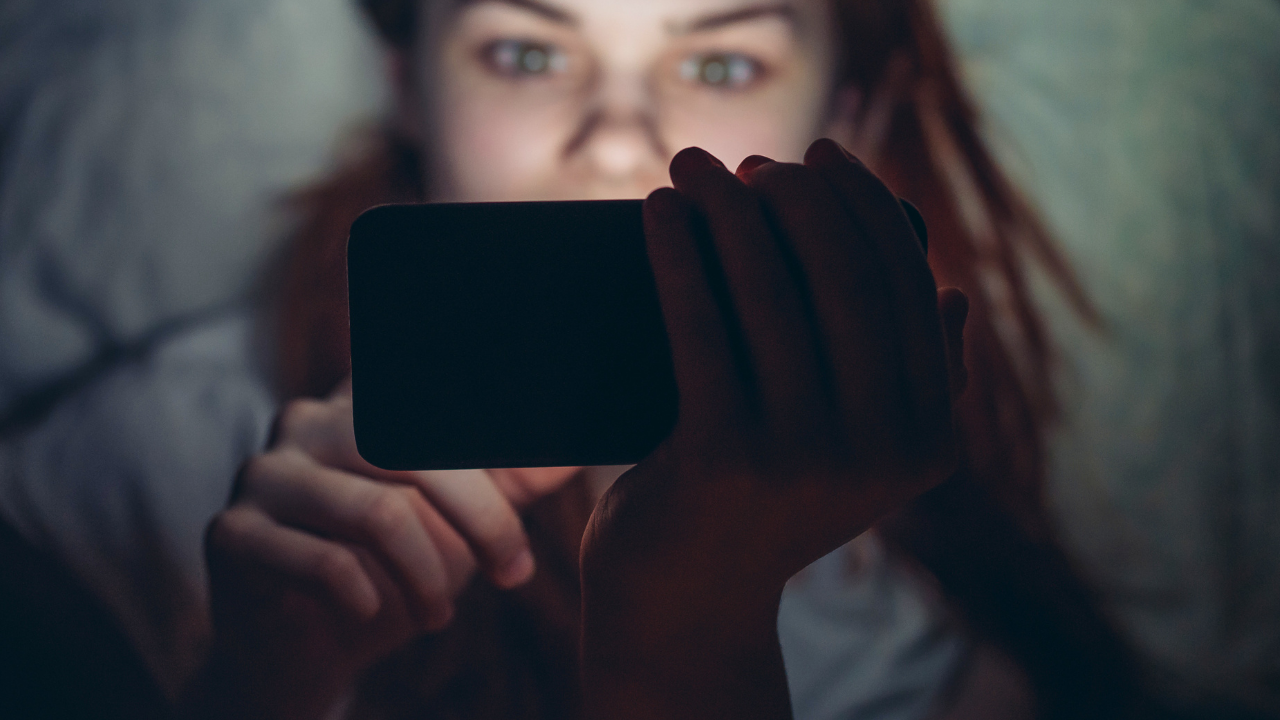
Screens Before Bed: What's Actually Happening to Your Sleep
Sep 07, 2026You tell yourself it's just five more minutes of scrolling. Then it's forty. Then you're wired at 11pm wondering why you can't fall asleep even though you're exhausted. Here's what's actually happening in your brain during that "just five minutes."
It's not really about the light. It's about what your brain thinks the light means.
The Melatonin Piece
Blue light does suppress melatonin release and can delay sleep onset, that part's real and measurable. A 2015 study found that reading on a light-emitting device before bed suppressed melatonin, delayed circadian timing, and reduced next-morning alertness compared to reading a printed book (Chang et al., 2015, PNAS). But for most people, it's a smaller piece of the puzzle than the marketing around blue-light glasses would have you believe.
The Bigger Culprit: Cognitive Arousal
Scrolling isn't passive. Novelty, social comparison, and notifications all spike mental alertness, keeping your brain "on" regardless of how dim the room is. A systematic review of screen time and sleep found that the content and engagement of screen use, not just light exposure, was consistently linked to delayed sleep onset and poorer sleep quality (Hale & Guan, 2015, Sleep Medicine Reviews). That's usually doing more to delay sleep than the light itself.
Why "One More Video" Never Feels Like Enough
Algorithmic feeds are built for continuous engagement. Unlike a book chapter or a TV episode, there's no natural stopping point, which is exactly why five minutes so easily becomes forty.
What Actually Helps
You don't need a total screen ban. A 20-30 minute wind-down buffer before bed, low-stimulation content if screens are unavoidable, and keeping your phone out of arm's reach all do more than any blue-light filter. One study of adult bedtime phone habits found that active phone use in bed, not just having the phone nearby, was associated with shorter sleep duration and lower sleep quality (Exelmans & Van den Bulck, 2016, Social Science & Medicine).
Your phone isn't the enemy. But if you're wondering why you're tired and wired at the same time, this is usually where to look first.
I remember when it shifted for me. Back when I was a graphic designer, I would stay up late working on projects, and after a long day, I would crash and scroll through my phone. I thought it would help me sleep. I had the glasses, the phone settings, I should have been good, yet my sleep was broken, and I would wake up more tired and unrested.
So I did what most people do, I overcompensated by restricting my screen time, deleting apps and swearing off social media. It helped, but I also felt disconnected. And that's when the shift happened. I discovered that the phone wasn't the problem, social media wasn't the problem either (it does share a bit of the blame). How I was using it was. I had tried both extremes, the no-boundary versus strict-boundary approach, all-or-nothing. I borrowed the mindset I coach my nutrition clients on and adapted it to my screen time. I scheduled some screen and social media time. This allowed me to still be present online, while not feeling left out or distracted. I didn't have as much of a need for it, especially before bed, and my sleep got much better.
There are no enemies, just choices to make.
If sleep has been the thing you keep meaning to fix and never do, start with a Wellness Audit and we'll map out what's actually going on.
Frank Madore is the co-founder of ThriveLife, helping parents build sustainable strength, nutrition, and energy without the burnout. Find more at @coachfrank.thrivewellness.
The ThriveLife Parent Wellness Audit is live.
A free 5-minute tool that shows you exactly where you're leaking energy as a parent — and what's actually worth fixing first.
Six pillars. Honest scoring. No generic advice. Just a clear picture of where you actually are and a specific direction forward. Takes 5 minutes. Free.